Invisalign vs Braces for Adults
A calm, plain language comparison built for adults weighing clear aligners against traditional braces. No sales pitch, no cheerful denial about the trade offs. Just what each option asks of you in daily life, what it tends to cost and how to decide which one fits your case.
This guide is editorial reference, not personal medical advice. A qualified orthodontist should make the final call based on your scans and bite.
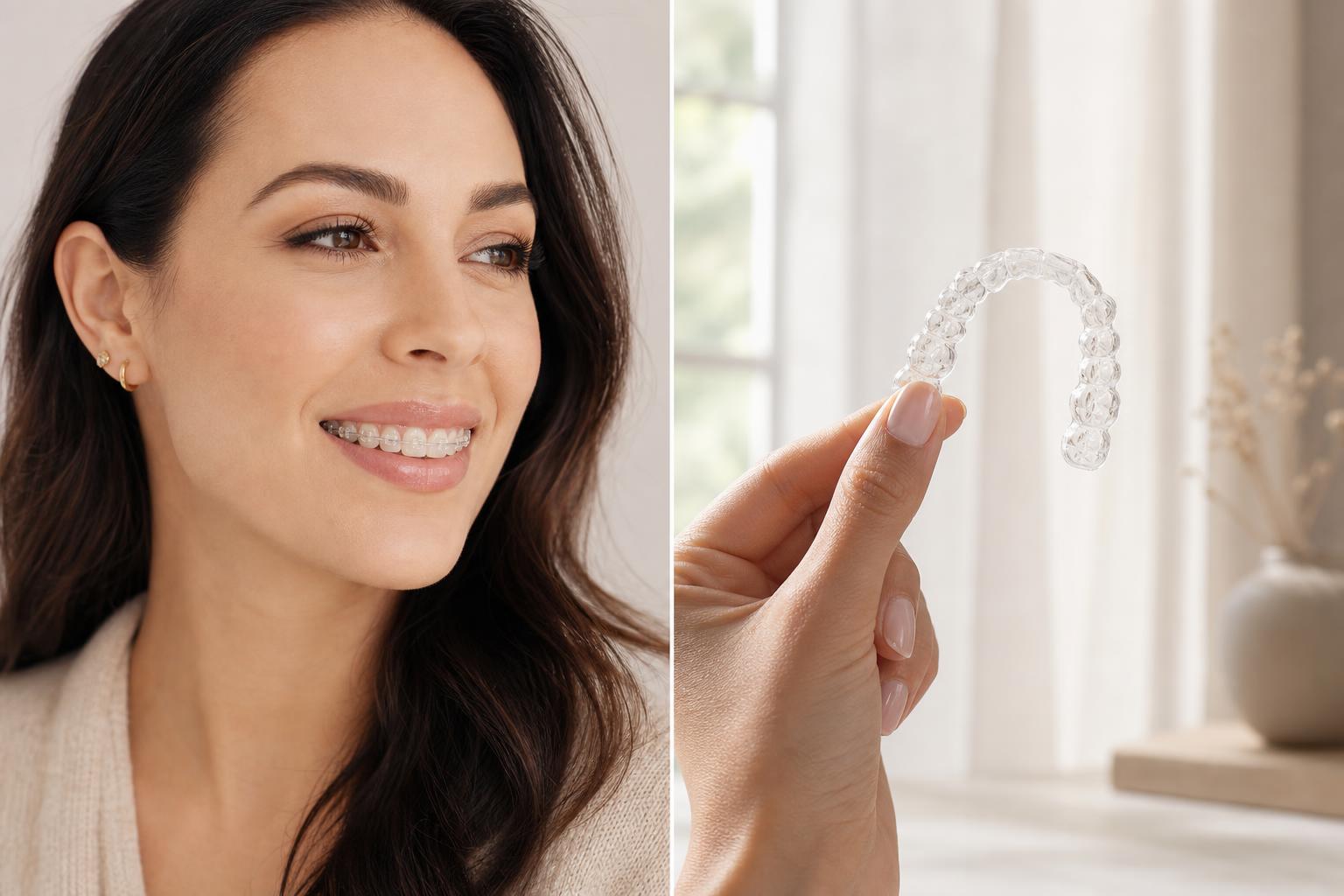
The short answer
For most adults with mild to moderate crowding, spacing or relapse from earlier orthodontic work, Invisalign and modern clear aligners deliver comparable results to traditional braces. Braces still hold an edge for complex bite corrections, large rotations and cases that need very precise control of individual teeth. The right choice usually comes down to three honest questions: how visible can your treatment be at work, how disciplined are you about wearing trays for 22 hours a day, and how complex is your case in the eyes of an orthodontist.
Side by side comparison
The numbers below are averages drawn from adult cases. Your timeline, comfort and cost can sit higher or lower depending on case complexity, geographic region and the experience of your provider.
| Factor | Invisalign and clear aligners | Traditional braces |
|---|---|---|
| Visibility | Nearly invisible clear trays | Visible metal or tooth coloured ceramic |
| Average adult timeline | About 12 to 18 months for typical cases | About 18 to 24 months for typical cases |
| Daily wear | Worn 20 to 22 hours, removed for meals | Fixed in place, no removal |
| Eating | Eat anything, then brush before reinserting | Avoid sticky, hard and crunchy foods |
| Cleaning | Rinse trays, brush and floss normally | Threader floss or water flosser around brackets |
| Office visits | Check ins every 6 to 10 weeks | Adjustments every 4 to 8 weeks |
| Comfort | Pressure for 2 to 3 days after each new tray | Soreness for several days after each adjustment |
| Speech | Mild lisp for about a week | Minimal speech change for most adults |
| Discipline required | High, success depends on daily wear time | Low, hardware works on its own |
| Typical cost range in the United States | Roughly 3,500 to 8,500 US dollars | Roughly 3,000 to 7,500 US dollars |
Invisalign and clear aligners
Pros
- Visually discreet, often unnoticed in meetings and photos
- Removable for meals, brushing and special occasions
- Easier daily cleaning of teeth and gums
- Fewer in office adjustments needed across the treatment
- Comfortable smooth edges with no brackets to irritate cheeks
Cons
- Success depends on disciplined 22 hour daily wear
- Attachments can be visible up close in bright light
- Mild lisp during the first week of a new tray series
- Less effective for complex bite or rotation work
- Only water can be sipped while trays are in
Traditional braces
Pros
- Predictable for complex cases, severe crowding and bite corrections
- No daily wear discipline needed, hardware does the work
- Ceramic options offer a more discreet look than metal
- Often slightly lower starting cost than Invisalign
- Easier for teens and adults who travel without routine
Cons
- Visible on the front teeth throughout treatment
- Long list of foods to avoid, including caramel, hard nuts and crusty bread
- Flossing requires threaders or a water flosser to be realistic
- Brackets and wires can irritate cheeks until you adjust
- More frequent in office adjustments, every 4 to 8 weeks
Realistic timelines
Adult timelines vary more than teen timelines because adult bone remodels slowly and many adults are treating relapse rather than a first ever correction. A useful planning range looks like this. Simple crowding or mild relapse with Invisalign usually wraps in 6 to 12 months. A typical adult Invisalign case runs 12 to 18 months, and complex cases can pass 24 months. Traditional braces sit a touch longer for mild work but often hold the same 18 to 24 month average for moderate adult cases, with complex bites sometimes reaching 30 months. Retainers are then a lifelong nightly habit for either option, because teeth keep drifting throughout adulthood regardless of how they were straightened.
Cost considerations
Published price ranges are averages, not quotes. Expect Invisalign to land between roughly 3,500 and 8,500 US dollars for an adult case, and metal braces to fall between roughly 3,000 and 7,500 US dollars. Ceramic braces typically run a few hundred dollars above metal. Several factors push the final number in either direction.
- Case complexity. Severe crowding, deep bites and rotations add trays, time and chair appointments.
- Geography. Coastal cities and capital regions price higher than smaller towns for the same treatment.
- Provider experience. A top Invisalign Diamond provider often quotes higher because their case planning reduces refinements.
- Refinements and retainers. Ask whether extra aligner trays, replacement retainers and follow up scans are included in the original quote.
- Insurance and accounts. A dental plan with an orthodontic benefit can offset 1,000 to 3,000 US dollars, and a health savings account stretches the rest with pre tax money.
Always request a written treatment plan with the total quote, the number of included trays or adjustments, the cost of refinements and the price of replacement retainers. A clear quote on paper prevents the most common billing surprises later in treatment.
Case complexity and what orthodontists actually look at
Consultations often feel like a sales pitch when they should feel like a diagnostic conversation. The orthodontist is looking at a handful of specific things when deciding which option gives the most predictable result. Understanding those factors helps you read the recommendation instead of just accepting it.
- Type of movement. Tipping a tooth into position is straightforward for aligners. Bodily movement, extrusion of short teeth and root uprighting are harder, and braces still hold an advantage for those movements.
- Rotation angle. Rotations under 20 degrees are usually predictable with aligners. Larger rotations of canines and premolars often need braces or aligners plus buttons, elastics and extra refinements.
- Bite depth. Deep bites and open bites respond well to both, but severe cases with skeletal components sometimes need braces plus temporary anchorage devices for a stable result.
- Crowding severity. Under 6 mm of crowding is usually a clean aligner case. Above that, some cases still finish with aligners but treatment tends to be longer and less predictable without expansion or extraction.
- Existing restorations. Crowns, veneers and short clinical crowns limit where aligner attachments can bond. Heavily restored smiles sometimes work better with braces because brackets bond to enamel in a wider range of positions.
Ask the orthodontist to name the two or three movements that are hardest in your case and explain why their chosen option handles them best. A confident answer here is worth more than any marketing brochure.
Daily life on each option
The abstract comparison shifts once treatment is underway. A realistic look at week to week life helps you predict which option will feel manageable and which will feel like a constant negotiation.
A typical day with clear aligners
You brush, insert your trays and head out. Coffee at your desk becomes a decision because dark drinks stain trays, so you either sip water only, remove the trays or accept some discoloration. Lunch means finding a bathroom to remove trays, eat, brush and reinsert within 30 minutes. Meetings, calls and photos happen without any hardware showing. At night you swap to a new tray if the week has ended, expect two to three days of pressure, then settle back into normal wear.
A typical day with traditional braces
You eat and drink normally, minus the restricted foods. Cleaning after meals takes longer because floss threaders or a water flosser are the only realistic way to reach between teeth. Wax stays in your pocket for the first few weeks in case a bracket rubs. Speech is normal from day one. Every four to eight weeks you visit the office for an adjustment, then feel soreness for two to three days afterward.
Neither option is objectively harder. Aligners front load willpower into every meal. Braces front load hygiene work into every brushing session. The right question is which trade off your existing routine already handles.
Comfort, pain and speech honestly compared
Marketing rarely gives a fair picture of comfort. Both options involve real pressure on teeth because that is how teeth move. What differs is the pattern of discomfort and how it shows up in daily life.
- First week soreness. Aligner users describe a dull, whole mouth pressure that peaks 24 to 48 hours after inserting a new tray. Braces users describe localized soreness on specific teeth that fades over three to five days after each adjustment.
- Soft tissue irritation. Aligners have smooth edges that occasionally trim into the gum line. Braces have brackets and wire ends that can rub the inside of cheeks and lips, especially in the first two weeks. Orthodontic wax covers rough spots.
- Speech impact. Aligners produce a mild lisp for most adults for the first three to seven days. Braces rarely affect speech beyond the first day or two, though lingual braces on the back of teeth are a notable exception.
- Managing discomfort. Ibuprofen or acetaminophen used per label instructions handles most soreness. Cold water and softer foods for two days after adjustments or new trays make a real difference. Persistent sharp pain is not normal and warrants a call to the orthodontist.
If chronic jaw pain, headaches or tooth sensitivity appear during treatment, ask about your bite. Both options can temporarily change how teeth touch and a bite adjustment sometimes solves what looks like a comfort problem.
Hidden costs people overlook
The number on the treatment plan is not the total number. A handful of secondary costs commonly show up during or after treatment for either option. Knowing them ahead of time keeps the budget honest.
- Retainers after treatment. Most quotes include the first set of retainers. Replacements cost 100 to 500 US dollars per arch depending on the type, and most adults need a replacement every few years.
- Refinement trays. Roughly one in three aligner cases needs a refinement round. Ask whether refinements are included, capped at a certain number or billed separately.
- Emergency visits. A broken bracket, a lost tray or a poking wire can add unscheduled visits. Some practices absorb these, others charge 50 to 200 US dollars per visit.
- Pre treatment work. Fillings, gum treatment, extractions and cleanings may be required before starting. These are separate from the orthodontic quote and can add 500 to 3,000 US dollars.
- Whitening after treatment. Many adults whiten once braces come off or during the final retainer phase. Professional whitening runs 300 to 800 US dollars, home kits around 100 US dollars.
How to choose without regret
A useful way to decide is to look honestly at three areas of your life and see which option lines up with the version of you that will actually finish treatment, not the version you hope to become.
Work and social visibility
If your work involves daily video calls, client meetings, presentations or being on camera, clear aligners let you keep your usual appearance. If your work is not visibility sensitive, braces stop being a concern within a few weeks as you and everyone around you stop noticing them.
Discipline and routine
Clear aligners require 22 hours of daily wear. If you already keep consistent habits, this is easy. If your schedule is unpredictable, if you eat frequently or if you find yourself talking through meals, the tray comes out too often and treatment stretches. Braces remove the daily decision entirely.
Case complexity
When two orthodontists tell you the same complex movements are hard for aligners, believe them. Adult treatment is slow enough without adding a year of refinements. A predictable finish in the option that fits your case is worth more than the aesthetic advantage of the option that does not.
Signals it is worth a second opinion
Second opinions are normal in adult orthodontics and most reputable practices expect them. A few situations make one especially useful.
- The recommendation is aligners for a case that involves large rotations, severe crowding or a significant bite correction.
- The quote arrives without a written breakdown of trays, refinements, retainers and replacement costs.
- The provider is a general dentist offering aligners as an add on service rather than an orthodontist with formal specialty training.
- You are told extractions are needed without a clear explanation of why the alternative would not work.
- The estimated timeline seems short compared with the ranges an independent orthodontist gives for a similar case.
Nothing about seeking a second opinion is rude. Most orthodontists respect the caution and many will offer to review a scan from another practice at a reduced fee.
Who each option fits best
Clear aligners tend to suit adults whose work depends on face to face confidence, who travel often and who already keep a consistent oral care routine. They reward disciplined wearers and quietly punish the ones who keep trays out for long lunches. Traditional braces tend to suit adults treating a complex bite, anyone worried about losing trays in airports and parents who would rather not negotiate tray time every evening. Many adults also choose ceramic braces as a quieter middle ground when aligners are not a clean fit for their case.
Questions to bring to your consultation
- Based on my scan, which option will give the most predictable result for my case?
- How many refinements are included in the original quote?
- What is your policy on replacement aligners or lost retainers?
- How often will I need to come in for check ins?
- What is the realistic total timeline, including retention?
- Will you be the orthodontist treating me, or a general dentist with aligner training?
Frequently asked questions
Keep reading
Once you have picked a direction, the next decisions are small daily ones. These guides cover the early weeks of either option without the usual clinical tone.
Get the free Aligner Starter Kit
A short, printable PDF with our daily cleaning routine, a brace friendly food list and the exact product checklist we use ourselves. Free, no spam, and unsubscribe with one click whenever you like.